The receipt
The consultant who bills for reading your email
On July 12, 2026, an engineering team at Systima put a logging proxy between their coding agents and Anthropic's API and read the receipts.
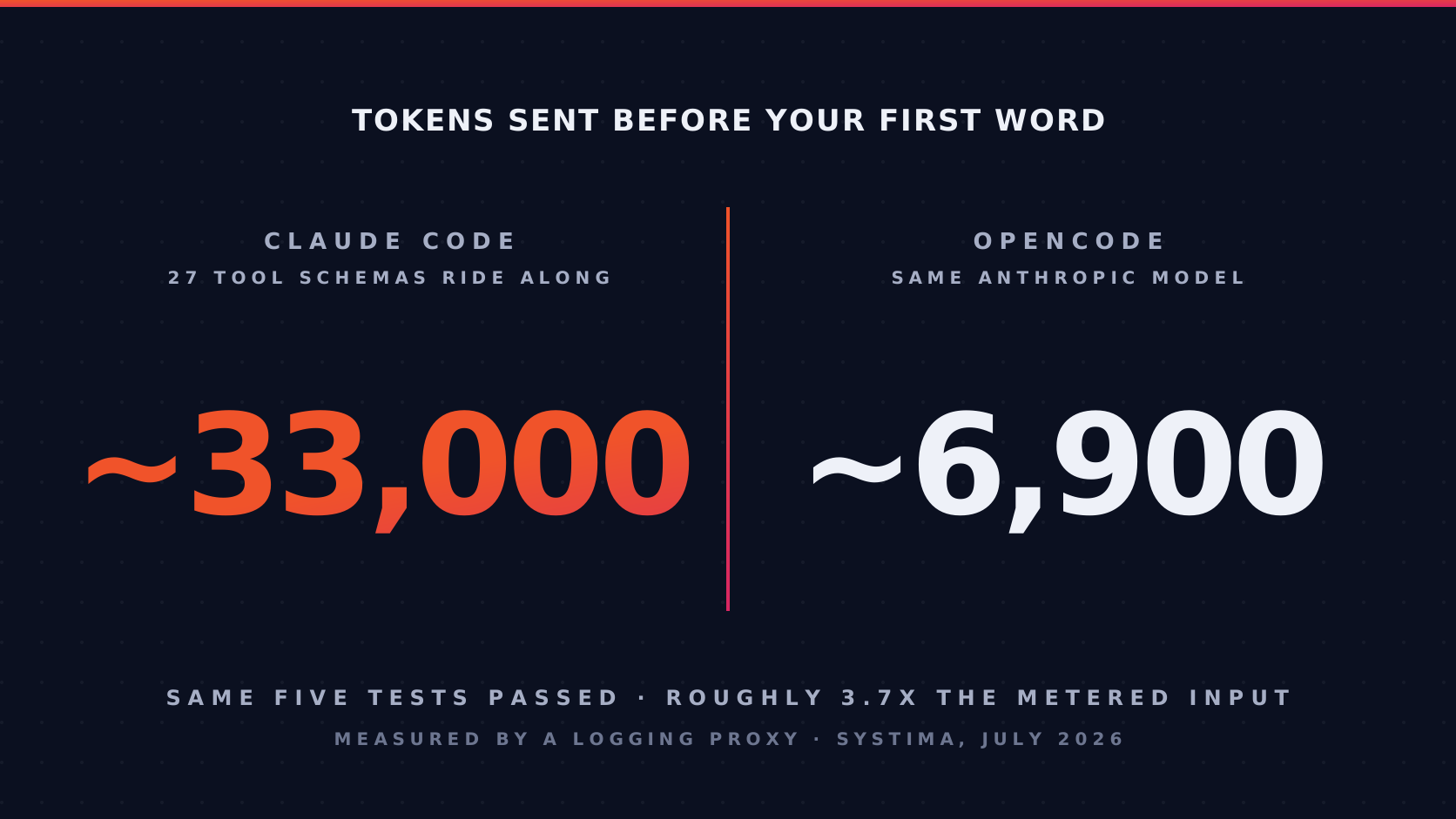
The teardown landed on Hacker News and collected 706 points, because the numbers were absurd in a way everyone had half-suspected and nobody had measured. Before processing a single word you typed, Claude Code's first-turn payload was roughly 32,800 tokens. OpenCode, pointed at the same Anthropic model, sent about 6,900. A 4.7x difference in baseline overhead.
Claude Code sending 33k tokens before reading the prompt is the AI equivalent of a consultant who bills you for the time spent reading your email before they even open it.
For two years this industry has argued about model pricing the way people argue about airfares while the baggage fees do the billing. In 2026 that stopped. If you've never asked what your harness sends before you say hello, this is the month to ask.
The replication
Same model, same tests, four times the bill
The Systima study's sharpest result isn't the payload size: the harness overhead bought nothing. Both Claude Code and OpenCode passed the same five-task suite, five out of five, on the same model — and the fat harness metered roughly 3.7x the input tokens per passing run.
Systima measured two harnesses. A June teardown on note.com had already put the same yardstick to Codex CLI and Pi, an open-source agent from late 2025 whose design bet is trusting the frontier model: a system prompt under 1,000 tokens and four tools. Side by side, the baseline reads like a menu:
| Harness | Before your prompt | Tool schemas in the opener | Measured |
|---|---|---|---|
| Claude Code | ~32,800 | 27 tools, ~24,000 tokens | Systima, July 2026 |
| Codex CLI | ~15,000 | — | note.com teardown, June 2026 |
| OpenCode | ~6,900 | 10 tools, ~4,800 tokens | Systima, July 2026 |
| Pi | ~2,600 | 4 tools, prompt under 1,000 tokens | note.com teardown, June 2026 |
August brought a preregistered replication. Researchers at PointFive ran identical model, task, and prompt combinations through Claude Code and Pi, and published the results on arXiv. Claude Code's fixed prefix: 15,983 to 20,330 tokens. Pi's: 1,147 to 1,642, a gap the paper puts at roughly 12–15x. Both harnesses solved the pilot tasks at close to 100%. Cost per success, though, ran 5–30x higher through Claude Code — about 18x in the paper's Nemotron example. Their conclusion, in the paper's own words: “harness choice dwarfs every prompt effect.”
Databricks made it three for three. In July they benchmarked coding agents against their multi-million-line codebase and reported the same shape: the minimal harness sent about 3x less context per turn and cost less than half as much per task, at quality they called identical. Per-task dollars stayed small — around two dollars for the frontier models — but the ratio is what compounds across a team.
Three independent measurements, one conclusion: on today's agents, the wrapper is a bigger pricing decision than the model.
The anatomy
Where the tokens actually go
It's not the system prompt. The famous “Claude Code has a giant system prompt” number that circulated in 2025 teardowns is stale twice over.
Anthropic removed over 80% of Claude Code's system prompt for its newest models in July 2026 — and the arithmetic barely notices, because the prompt was never the bulk of the payload. Tool schemas are. Take Claude Code's ~33,000-token opener as Systima measured it, twelve days before that trim: roughly 24,000 tokens are definitions for its 27 tools, versus about 4,800 for OpenCode's 10. One tinkerer who captured the traffic with mitmproxy double-checked the raw payload: 162KB of JSON, per session.
The overhead keeps spending after the handshake. The founder of Quesma, which tested trivial prompts across 14 models, reported in the same thread that inputs like “Hey” or “commit” sometimes triggered more than 30 tool calls. His word for it: “tokenflation.”
Then there's the accumulation mechanic, which cloud-cost vendor Vantage spelled out in April 2026: “Every API call sends the model its full context as input tokens.” A 50-turn agent session in their model consumes roughly one million input tokens against 40,000 output — a 25:1 ratio. You're paying it to re-read the conversation, every turn, forever.
In April 2026 a developer spending about $1,400 a week on Claude Code built a tool to classify his own session transcripts and published the breakdown: 56% of his spend was conversation turns with no tool usage at all. Actual code edits: about 21%. The majority of a working engineer's agent bill was, functionally, talking.
The rebuttal
The cache is the business model
The obvious rebuttal arrived in the HN thread within hours: prompt caching makes fat prefixes nearly free.
Anthropic bills cache reads at a tenth the price of fresh input (as of August 2026: $0.50 per million tokens on Opus 5, against $5.00 fresh). One commenter was blunt: “So? it doesnt matter, after the first turn it's cached. We are probably talking about single digit cents.” Another ran the break-even logic: if a 33K-token prefix saves the agent a few turns of dynamic discovery later, it pays for itself quickly.
Both are right, as long as the harness never breaks its own cache. That's the part the receipts contradict. Systima's cache-write column showed Claude Code writing 53,839 cache tokens across five requests on a task where OpenCode wrote 1,003. One of those writes was a mid-task rewrite of its full prefix, by then grown to roughly 43,000 tokens. Cache writes bill at 1.25x to 2x fresh input, so a harness that rewrites its prefix mid-session isn't amortizing its overhead. It's buying it again, at a markup.
Cache pricing breaks intuition in the other direction, too. In July 2026, JetBrains tested a popular “token-saving” hook called rtk, which advertised 60–90% less token consumption. Across 80 paired real-world tasks it measured a median 7.6% cost increase at low reasoning effort (p=0.004) and a flat zero at high effort. The tokens the hook “saved” were mostly cache reads already billing at a tenth of list price, and the extra turns it induced cost real money.
The multiplier
Fan-out is a force multiplier on waste
Everything above describes one agent. The current fashion is to run several.
Systima measured a small task that cost 121,000 tokens done directly ballooning to 513,000 tokens when the harness fanned it out to two subagents — a 4.2x multiplier, because every subagent carries the full prefix and the orchestration overhead on top. Anthropic's own cost documentation says agent teams use approximately 7x more tokens than standard sessions.
The lived version of that stat, from the 706-point thread: “it immediately launched 7 sub agents which burned through my budget before even one of them was finished... If I let the main agent do the same task sequentially, it was no problem at all.”
At the far end of the fan-out curve sits Peter Steinberger, the OpenClaw founder, whose 30-day OpenAI bill — $1.3 million for 603 billion tokens across 7.6 million requests, running around 100 agents — made the rounds in May 2026. His aside: turning off “Fast Mode” alone would cut costs by 70 percent. No model choice on the menu comes close to that lever.
One honest caveat, from the same Systima data: the tax isn't monotone. On one task, Claude Code's aggressive batching — the whole job in one round trip — beat OpenCode's turn-by-turn approach, 121,000 metered tokens to 132,000.
The other side
The steelman: the harness also sets the score
Daniel Vaughan spent the spring documenting what he calls the harness effect: by his April tally, the same Claude Opus weights score 77% on Terminal-Bench 2.0 inside default Claude Code and 93% inside Cursor. Sixteen points, zero model change.
He calls understanding it “the single highest-leverage optimisation” available to teams deploying agents. Endor Labs found the same thing from the security angle in April: GPT-5.5 scored 87.2% on functional correctness through Cursor's harness and 61.5% through Codex — a 25.7-point spread on identical weights, same week.
Anthropic made the cost-quality trade explicit in a March engineering post: the same application built by a solo agent took 20 minutes and $9; built through their full planner-generator-evaluator harness, six hours and $200. Their verdict: “The harness was over 20x more expensive, but the difference in output quality was immediately apparent.”
Next to payroll, the per-seat numbers are a rounding error. Anthropic's enterprise figures, current as of August 2026, put the average at around $13 per developer per active day. Microsoft Research's telemetry study of Copilot-style agent adoption, published in July, measured adopters merging roughly 24% more pull requests than they otherwise would have. If a $2 task resolves and a task at a thirtieth the price doesn't, the $2 task is the cheap one.
The steelman survives contact with the data — but only where the overhead buys outcomes. The harness effect argument earns the fat harness a hearing. It doesn't earn it a blank check.
The invoices
The bill has reached the CFO
Harness economics stopped being a nerd topic in spring 2026, when the invoices reached people with budget authority.
In July, a screenshot titled “$200 subscription vs $7,470 of API usage” collected 531 upvotes on r/ClaudeAI: one month of Claude Code on a $200 Max plan, metered at API rates, would have cost 37x the sticker. Microsoft started canceling Claude Code licenses in May as spend ran far past flat-rate budgeting. Bloomberg reported in June that Uber capped employee usage of AI tools including Claude Code to cut costs. One European engineer did the retail math: the same agentic tasks that cost his colleague €100 a day metered through AWS Bedrock fit inside a €20-a-month subscription elsewhere.
A pricing model can't survive a 30x variance in appetite. On April 2, 2026, OpenAI moved Codex off per-message billing onto raw token credits — flat “messages” died because two messages can differ a thousand-fold in cost. Sourcegraph's Amp walked the same road, adding monthly subscriptions in July after starting out purely pay-per-token. Everyone is converging on the same uncomfortable middle, because the harness made usage too lumpy for either pure model to price.
What to do
Audit the wrapper
Treat your harness the way you learned to treat your cloud account: as a system that spends your money according to opinions you never reviewed.
The audit is a weekend, not a quarter. Put a logging proxy on one working session and read what your harness sends before your prompt; Systima's study is a repeatable method. Read the cache-write column, not the input total; a mid-session prefix rewrite is money on fire. Check what fan-out costs you with your workload, because “approximately 7x” is Anthropic's own number, not a critic's. When you compare harnesses, compare cost per resolved task on your codebase — the only denominator that survived every study this year.
- Proxy one sessionLog what your harness sends before your prompt. Systima's teardown is a repeatable method
- Read the cache-write columnWrites bill at 1.25x to 2x fresh input, so a mid-session prefix rewrite is money on fire
- Price the resolved taskCost per resolved task on your codebase is the only denominator that survived every study this year
A July 2026 arXiv paper from Writer measured a harness redesign cutting blended cost per task by 41%, from about $0.21 to $0.12, and tokens per task by 38%, with a 99.9% cache-read rate on the static prefix. Models held constant, at a modeled scale of a million tasks a month. Someone just engineered the wrapper.
2026 will read as the year the harness got its own line item, with its own pricing behavior, regressions, and levers worth 70% of a seven-figure bill. The models will keep getting cheaper. Your agent bill might not. So before you sign next year's contract, take the consultant joke seriously: ask what you're billed for before your agent even opens your email.