The claim
Not even Paul Graham knows
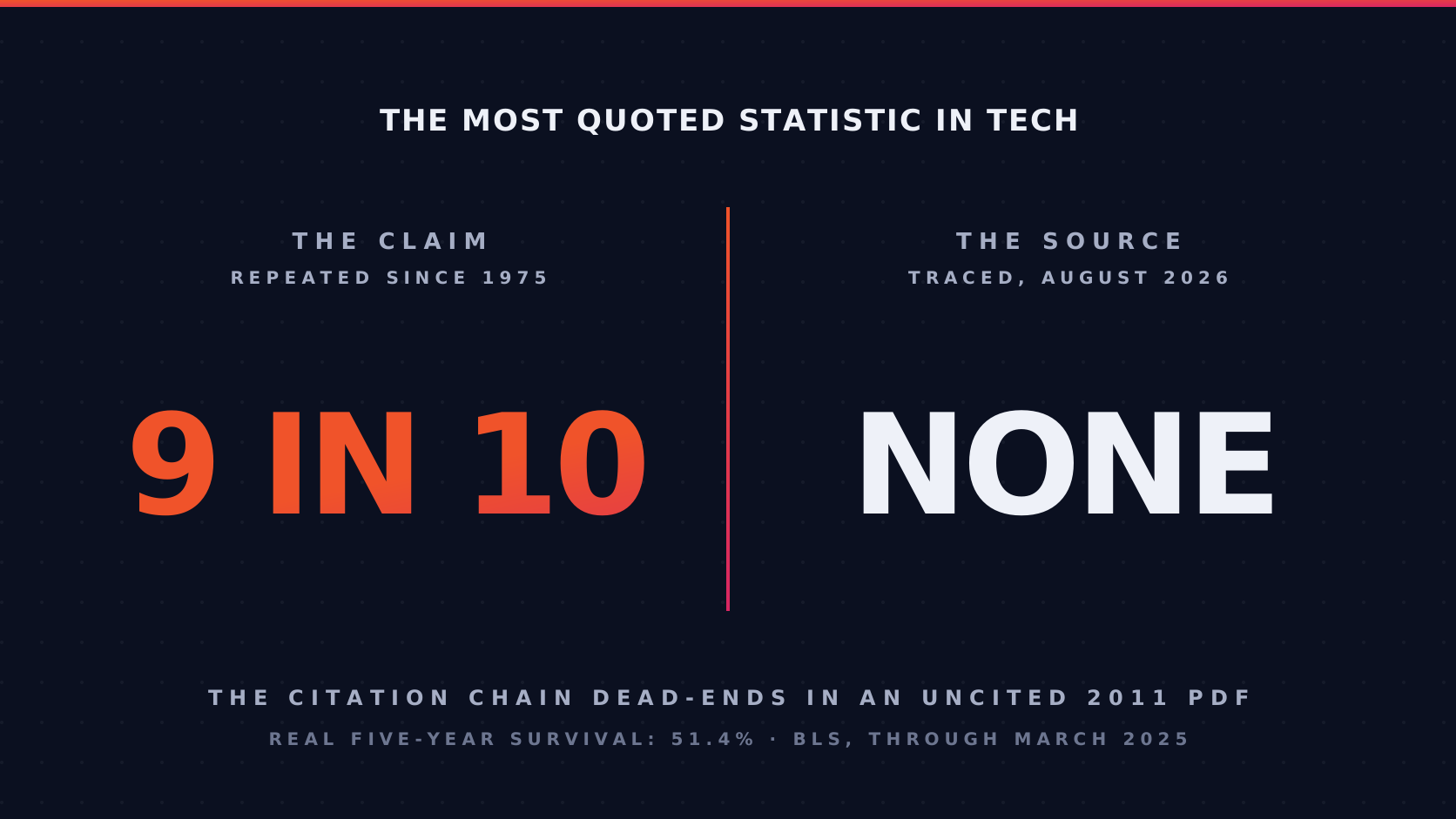
Nine in ten startups fail. Nobody can tell you where it comes from: not the founders who repeat it, not the investors who price by it, not the man who ran Y Combinator.
Pull the thread and it dead-ends on page 3 of a 2011 PDF, in a sentence with no footnote. In an April 2011 Hacker News thread titled “What is the truth behind ‘9 out of 10 startups fail’?”, Paul Graham wrote:
I have no idea where the rule of thumb that 9 out of 10 startups fail comes from, but it doesn't sound too far off.
In the same thread, a commenter called the number “total nonsense propagated because people like to think they're special for lasting” — then claimed it “was made up in a NYT article 10 years ago,” also without a source. The stat's defenders can't cite it. Its debunkers can't cite their debunking. That's not how facts behave. It's how folklore behaves.
The trace
The paper trail ends in a PDF
Failory's “Startup Failure Rate” page, updated January 12, 2026, headlines the claim and admits: the 9-out-of-10 figure “seems to originate from the Startup Genome project.” Startup Genome's 2019 Global Startup Ecosystem Report says “only 1 in 12 entrepreneurs succeed” and cites Startup Science, the same team's follow-on project. The Startup Science trail runs back to the 2011 Startup Genome report on premature scaling, which opens, on page 3:
More than 90% of startups fail, due primarily to self-destruction rather than competition.
No citation. It isn't even the report's own finding: that one, from 3,200 self-selected tech startups, was about premature scaling. Two hundred lines later the same document refers to “the 90% failure rate of startups” as if it had been established in between. It hadn't. The chain is a circle with a hole in the middle.
Startup Genome didn't invent the folklore. The April 2011 Hacker News thread already treats nine-in-ten as an old rule of thumb, months before this report circulated. What the report did was give it a body: something a journalist could finally cite.
The number's most famous cousin is worse. “8 out of 10 businesses fail within 18 months” ran in Forbes in September 2013, attributed to Bloomberg. In April 2016, Tech.co went looking for the Bloomberg study and found it does not exist. Unlinked, unfindable, still quoted today.
The deep history is where it gets properly stupid. In October 2024, product researcher Jeroen Coelen traced the generic “90% of businesses fail” claim to a 1975 Dun & Bradstreet failure report, where the figure never appears. The report tallied the ages of roughly 11,000 failed companies without counting how many companies existed in each age group, which makes a survival rate uncomputable. A 1978 re-analysis by Michael Massel did the missing division against all 2.5 million U.S. companies then in existence, a stock of mostly mature firms, and got an annual failure chance of about 0.43%. Ninety percent is what a journalist's misreading of a table looks like after fifty years of compounding. The statistic is older than the industry it describes.
The ledgers
One article, four failure rates
The U.S. Bureau of Labor Statistics tracks every new private-sector establishment — every salon, plumbing outfit, and taco truck, not just startups. Its Business Employment Dynamics survival tables, current through March 2025: 77.9% were still alive after one year, 51.4% after five, 34.7% after ten. And “exit” there includes mergers and relocations, not just death. About half of everything is gone in five years. Not nine in ten. Not eighteen months.
- Still alive at 1 year
- 77.9%
- every new U.S. establishment, not just startups
- Still alive at 5 years
- 51.4%
- “exit” includes mergers and relocations
- Still alive at 10 years
- 34.7%
- BLS Business Employment Dynamics, through March 2025
For venture-backed companies, the best large dataset remains Cambridge Associates' 27,259 VC-backed startups from 1990 to 2010, dug up by Erin Griffith in Fortune in June 2017. Defining failure as returning 1x or less to investors, the failure rate never exceeded 60% after 2001. Its all-time peak (the dotcom bust) was 79%. Even the worst year in venture history couldn't produce nine in ten.
The piece everyone half-remembers as the stat's academic source is a September 2012 Wall Street Journal article on Harvard Business School researcher Shikhar Ghosh's study of 2,000+ venture-backed companies. Inside that one article: the National Venture Capital Association estimates 25–30% of venture-backed businesses fail; Ghosh puts liquidation, where investors lose everything, at 30–40%; three out of four venture-backed firms don't return investors' capital; and if failure means missing your projected ROI, “more than 95% of start-ups fail.” One article. Four failure rates, 25% to 95%. The retellings kept the 95% and dropped the definition.
The steelman
Nine in ten of what, exactly
Inside the venture game, the arithmetic of ruin is real. The Linux kernel's Ted Ts'o, relaying Christoph Möller's answer in that same 2011 thread, spelled out the VC rule of thumb: of every ten startups, three fail outright, three return less than the capital invested, three merely return it, and one pays for the rest. Nine of the ten miss venture-scale returns; six never even return the capital, the bar-napkin version of Ghosh's measured 75%.
Fifty years on, the ledgers side with the bar-napkin math. Carta's fund performance report for Q3 2025, published December 2025, shows only 42% of 2020-vintage VC funds with a DPI above zero. Five years in, the other 58% had returned zero dollars. Not “underperformed.” Zero dollars. NanoGlobals' long-running teardown of the stat, updated February 25, 2026, concludes the 90% figure roughly holds for venture-backed startups over a ten-year window, provided “success” means returning at least 10x, the winner's bar that venture portfolio math is built on.
Paul Graham's instinct was right about one game: the one almost nobody quoting the stat is playing. “Nine in ten venture-backed startups fail to produce venture-scale returns within a decade” is a defensible sentence. Nobody repeats that one. What gets repeated is “nine in ten startups fail,” applied to a bootstrapped SaaS, a plumbing company, and your cousin's Shopify store — populations where the measured number is half, over five years, counting mergers as deaths. The number was measured at the poker table and gets quoted at the kitchen table.
The gray zone
Failure stopped being a binary
Even inside venture, the stat's yes/no frame no longer describes reality. The modal outcome now is neither death nor glory. It's limbo.
In June 2026, The Economist reported data from Stanford professor Ilya Strebulaev's unicorn database, quoted in a 169-point Hacker News thread: by May 2026, 332 of 1,900 tracked unicorns had raised flat or down rounds (money at or below their prior peak valuation), and 383 had disclosed no new funding in three years. One commenter did the division and shrugged: “332 out of 1900 isn't that bad?” Another pushed back on the framing itself: “finance bros call any healthy company that isn't on an extreme growth path ‘zombies’… in reality many of these are perfectly healthy companies doing fine.” Both can be right, which is the problem with a one-number failure rate.
The deaths that do happen have moved upmarket. SimpleClosure's State of Startup Shutdowns report, December 2025, shows Series A companies jumping from about 6% to about 14% of shutdowns in a year. The median dissolving company had raised $2.8M; the average Series A casualty was about seven years old. Companies that cleared every early bar, then died anyway, slowly.
There's the column the stat has no name for. On August 4, 2026, Bending Spoons agreed to acquire Airtable for $1.285 billion: a company with roughly $480 million in ARR still growing 20% a year, selling at about a ninth of its $11 billion-plus 2021 peak valuation. Is that a failure? The 2021 cap table thinks so. The balance sheet disagrees. A billion-dollar exit lands in the “nine in ten” whenever the storyteller needs it to.
The founders have stopped talking in binaries. A March 2026 r/SaaS post (205 upvotes) itemized a shutdown: eighteen months, $3,200 peak MRR, roughly $40K in and $28K back. In a March 2026 r/ycombinator thread a founder tallied: “Had a cushy FAANG job. Decided to start a business. Raised $500k for pre-seed round. Lost it all within 24 months.” Two failures later, his bootstrapped products are at several million in ARR. Which row of the failure table does he go in? The stat counts ventures; founders run careers.
The live demo
Watch a zombie statistic being born
You watched it happen in August 2025.
MIT's NANDA initiative circulated a preliminary working paper claiming 95% of enterprise generative-AI pilots produce zero return — a figure built on about 52 interviews, distributed behind an email form. Fortune's coverage hit Hacker News at 230 points. Within three days the claim had mutated into a harder one: “95% of Companies See ‘Zero Return’ on $30B”, 418 points. One commenter dissected it: “I thought it was a low quality article with no data or in detail methods. MIT needs to do better.”
In the very thread tearing apart an unsourced 95%, a commenter reached for context: “I heard that SAP has an 80-90% deployment failure rate back in the day, but don't have a citable source for it.”
The original keeps inflating, because nothing anchors it. A July 2026 comment in a 246-point thread: “If 90% of tech startups failed in the past, AI pushes that that rate to over 99%.” A May 2026 r/startups post (477 upvotes) asserts “Something like 99% of tech startups fail,” and hundreds of comments argue about everything except the number. Ninety became ninety-five became ninety-nine. No study happened in between. None was needed.
The autopsy
Why the number refuses to die
It survives because every person in the room is paid, in some currency, to believe it.
Failed founders get absolution: you can't be blamed for losing a game that was 90% unwinnable. Investors get a power-law justification for spraying checks. Successful founders get to be the one in ten: you don't repeat a stat that makes your win one coin flip in two. And the advice industry gets a disease to sell the cure for. As one commenter put it under Steve Blank's April 2026 essay: “startup failure rate hasn't dramatically shifted despite two decades of lean startup methodology, accelerators, and an entire cottage industry of startup advice. It's never the fault of the framework, mind you.”
Erin Griffith called this in 2017: “It comforts failed startup founders who burned through their investors' money, laid off staff, and shut down their companies.” Her conclusion: “Normalizing the failure narrative only conceals the truth, misleads founders, and in certain cases, explains away bad behavior.”
A zombie statistic has four tells:
- No primary sourceTwo clicks don't get you to one
- Suspiciously roundAnd rounder with age
- Definition-proofSurvives every change of definition, population, and decade, which no measured quantity does
- Flatters the tellerWhoever repeats it wins something
The real numbers are better than the fake one: about half of new businesses are gone in five years; most venture bets never return their capital; a majority of 2020 venture funds have yet to send a single dollar back. Those numbers have authors, populations, and dates. The famous one has none of the three: it was asserted in a PDF in 2011, misread from a table in 1975, and repeated by people who would fail a due-diligence check they'd never run on a sentence. Next time a deck opens with “nine in ten startups fail,” ask the presenter: which nine, of which ten, counted by whom? As of August 2026, fifty years into this number's career, nobody has ever answered.