Diagnosis
The tiredness got a name
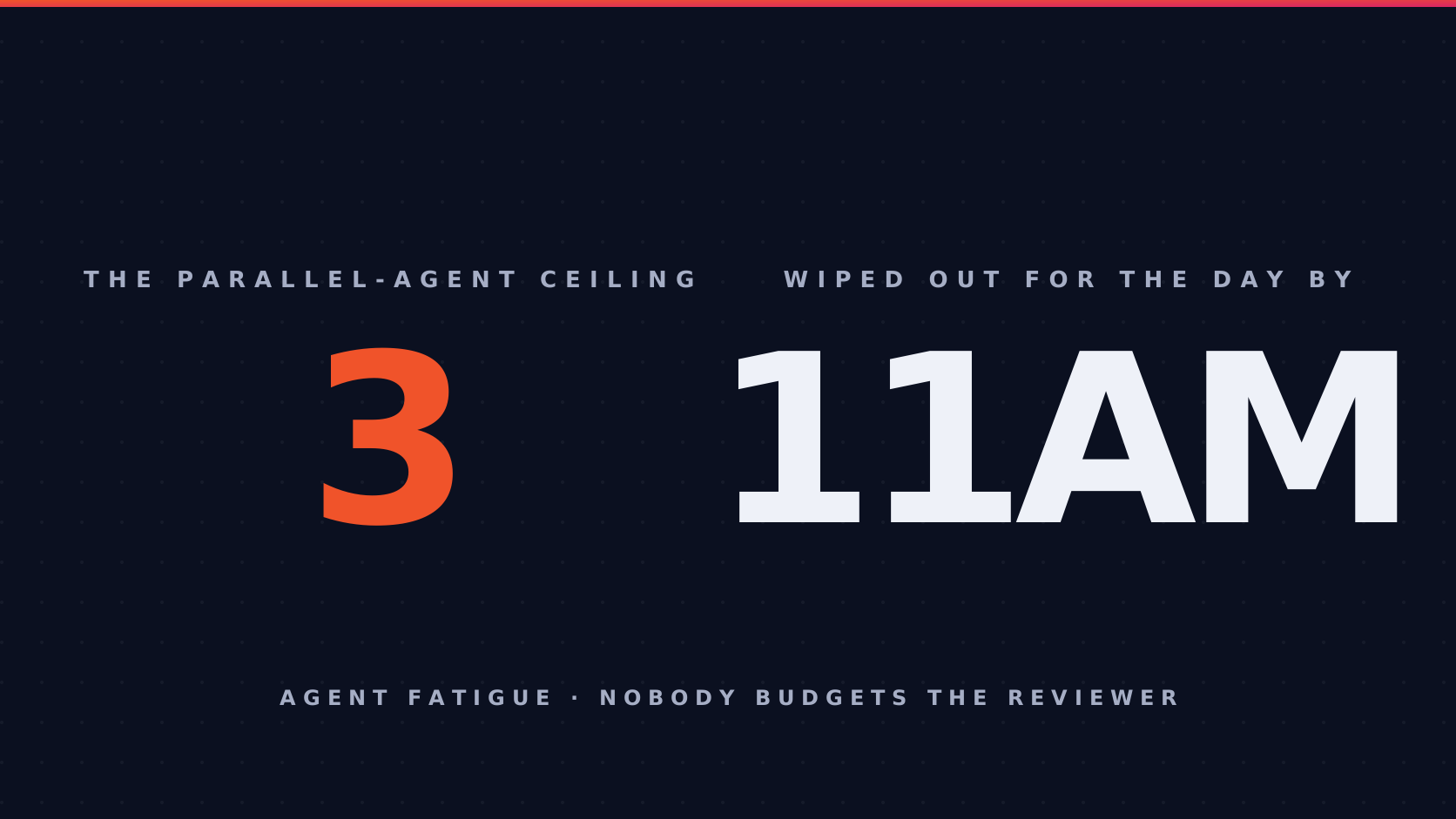
Simon Willison can run four coding agents on four problems at once. He also reported, on Lenny's Podcast in April 2026, what that costs: he's “wiped out for the day” by 11am. “There is a limit on human cognition. It's very easy to pop that stack.” The 2026 discourse has benchmarked everything about coding agents (tokens, merged PRs, review queues, invoices) except the component that degrades fastest under load: the person supervising them. Teams budget tokens to the cent. Nobody budgets the reviewer.
In July 2026, Pydantic published “The human-in-the-loop is tired” and Hacker News pushed it to 318 points, because it named the mechanism everyone was feeling. Hand-coding paid out constant small rewards: a problem solved, a test passing. Agent supervision strips those out and replaces them with pure review load. Nobody ever got a dopamine hit from clicking Approve. The article calls it the human reward function problem, and the thread under it supplied the war story: an engineer “waking up to thirty PRs every morning, each one pulled overnight by someone's AI,” making snap judgments on each and wondering, if he delegates the reviewing too, “at that point, what am I still doing here?”
“Creating is energizing. Reviewing is draining.” Siddhant Khare needed six words for it in February. By March the condition had names on both ends of the discourse: “agent fatigue,” coined in a Hacker News thread whose author felt “inside some kind of experiment where my apathy and internal clock displacement are being evaluated,” and “AI brain fry,” from a March 2026 BCG study of AI-heavy workers covered by Built In: 14% of AI-using workers report it, sufferers make 39% more major errors, and 34% show intent to leave their jobs against a 25% baseline.
Cognitive load
Three agents, then the cliff
Addy Osmani put a number on the ceiling in an April 2026 post: three to four parallel threads, because “your cognitive bandwidth doesn't parallelize.” He also named the cost of exceeding it, the “ambient anxiety tax” of threads silently going sideways while you look elsewhere. His advice runs opposite to every launch demo: start one thread fewer than feels comfortable.
- Agent ceiling
- 3–4
- parallel threads before the cliff
- Sunday activity
- +58%
- 163k-employee workforce data
- Major errors
- +39%
- among workers reporting brain fry
The people who tested the high end agree. Zach Wills ran twenty flat parallel agents for a week in 2025 (800 commits, 100+ PRs) and described “constant situational awareness” across terminals: “three hours of it left me burnt.” His July 2026 revision runs three to four long-lived orchestrator threads with disposable workers behind one merge gate. “It's really just like managing four people.” And on July 29, a 306-point HN thread titled “The Productivity Mirage” added the self-measurement nobody wants to do: “Before I was doing the context switching dance I felt I was going at 10x, but realized I was only perhaps going at 2x. Now I have severely reduced the number of agents.”
There are outliers: one commenter in a June flow-state thread keeps “49 agent sessions open, 5-15 going at a time.” The same thread has a developer taking gummies to feel connected to work and another who picked up drawing because the career's reward is gone. The distribution has two tails, and the 49-session guy is not the one that should worry you.
Role drift
Manager schedule, IC paycheck
A 785-point July 2026 thread found the frame for why this exhausts people who used to thrive on hard work: agent fleets are Paul Graham's maker/manager schedule imposed at massive scale. Individual contributors are being force-converted to manager-style multitasking they never trained for, without the manager's compensation or authority. The interruption arithmetic is brutal at the small scale too: a July r/ClaudeAI thread describes permission prompts arriving every two to three minutes as “the worst of both worlds. There isn't enough for me to do between interruptions to do anything else meaningful.”
Kent Beck ran a coordinator/implementer/verifier swarm on his own project and wrote it up in April 2026 as “Genie Lessons: Nobody Wants Agents”: “I was managing it. Watching which agent was doing what. Wondering when to interrupt. Holding state in my head that the system should have been holding for me.” When Peter Steinberger posted in June that you should stop prompting agents and start designing loops that prompt them, the reply wave was instructive: one newsletter's tally put 61% of responses at “bad advice, premature, or just insulting,” with the recurring jab that a loop is “a cron job wearing a hoodie” and that loop evangelism just relocates the babysitting. One newsletter's count, not a scientific sample, but nobody disputed the volume.
Gatekeeper anxiety
Review was never the fun part
The fatigue concentrates exactly where the past year's productivity concentrated: review. Stack Overflow's blog put a case study on it in May 2026: a Smartsheet engineer produced seven times her team's code, and “the other six people were spending the majority of the time reviewing her code.” Intuit's Carol Lee named the emotion underneath, gatekeeper anxiety: “If I mess up this review, I was the gatekeeper of this code.” On Reddit the same month, a senior described “drowning” in 10,000-line AI PRs while management “couldn't understand” that the seniors were absorbing the debt.
That's the context for the loudest r/ExperiencedDevs thread of the spring, the developer who announced at a company all-hands that he was done reviewing AI-generated PRs (1,560 upvotes, May 2026). The detail everyone quoted from it was the sign-off:
I can now go back to what I love the most -> writing code :D
A grown senior engineer, smiley included, celebrating permission to do his own job. The craft loss shows up over and over in the July threads: “I used to get overjoyed and would tell my partner how amazing programmer I am every time I built something difficult. Now I just don't get that feeling on finishing 10 features.” The best one-line diagnosis, from an Ask HN in July: AI moved coders from author to editor, and editor is a different career nobody chose.
Always on
The machine never idles, so neither do you
The always-on cost has measurements now. A March 2026 LeadDev report collected them: a 19.6% rise in out-of-hours commits across 500+ developers, and workforce data from 163,000 employees showing Saturday productive hours up 46% and Sunday up 58%. Developers prompt agents before breaks so the machine never idles. One principal engineer: “I'm coding into later hours because I can't get myself to get up from the computer.”
The psychology underneath is the slot machine, and 2026 said so from three directions. Axios ran the headline in April: “They operate like slot machines: AI agents are scrambling power users' brains.” A May post by a developer writing as Sid did the arithmetic: variable rewards followed by cognitive fatigue, with four to five supervisory hours draining him like eight to ten normal ones. And Rootly's CTO Quentin Rousseau supplied the image that sticks, in his own March 2026 post: “The prompts kept composing themselves behind my eyelids. My body was in bed but my mind was still in the terminal.”
Some of the vigilance is rational. A PM at one company asked Cursor's agent in June to tag 87 backlog tasks, went to a meeting, and returned to a $1,382.59 bill from an hour-long tool-call loop. An agent you can't leave alone for an hour is a toddler with API keys, not an employee.
The playbook
Budget attention like you budget tokens
Our read: agent fatigue is a design smell, not a personal failing. The coping playbook emerging from the 2026 threads treats it that way, and it is unglamorous and consistent.
- Cap the fleetTwo agents per project, three on a good day, never two debug sessions at once
- Protect maker timeAI-free mornings, a three-prompt rule, hand-write the parts you love
- Keep boring workRoutine tasks decompress; automating all of them is how you burn out
The fleet cap comes from a 30-year veteran's May 2026 confession, the most detailed of the period, from a developer who ended evenings “willing to throw my computer out of the window screaming” before he imposed it. The maker-time rules are Khare's self-rescue (AI-free mornings, a three-prompt rule before writing code manually), plus the July developer who inverted the loop entirely, writing complex features by hand and having AI review, which “brought back the old feelings of excitement.” The boring-work defense held a 266-upvote March thread: routine tasks “help me decompress,” with one engineer declining to “outsource my brain to Anthropic.”
All of these are attention budgets. Management is often actively making it worse: an April thread described managers decreeing a 5x speedup with no basis (“forcing an arbitrary goal on people will lead to burnout”), and a February one described tracked AI usage where more usage reads as better performance, so engineers run agents on tasks that don't need them to make their numbers look good.
The three-agent ceiling is as real a constraint as your context window, and the teams that treat human attention as the scarce, budgeted resource — the way they already treat tokens — are the ones that will still have their senior engineers in two years. The exits are already visible: the February “AI Depression” thread from a 25-year veteran thinking of leaving the industry, and the developer laid off in May who became a mail carrier and wants “nothing to do with AI.” Your agents will be fine. They don't get tired. That was never the question.